 Add to Chrome
 Add to Firefox
 Add to Edge
A Multimodal Data Collection Framework for Dialogue-Driven Assistive Robotics to Clarify Ambiguities: A Wizard-of-Oz Pilot Study
Jan 23, 2026
Integrated control of wheelchairs and wheelchair-mounted robotic arms (WMRAs) has strong potential to increase independence for users with severe motor limitations, yet existing interfaces often lack the flexibility needed for intuitive assistive interaction. Although data-driven AI methods show promise, progress is limited by the lack of multimodal datasets that capture natural Human-Robot Interaction (HRI), particularly conversational ambiguity in dialogue-driven control. To address this gap, we propose a multimodal data collection framework that employs a dialogue-based interaction protocol and a two-room Wizard-of-Oz (WoZ) setup to simulate robot autonomy while eliciting natural user behavior. The framework records five synchronized modalities: RGB-D video, conversational audio, inertial measurement unit (IMU) signals, end-effector Cartesian pose, and whole-body joint states across five assistive tasks. Using this framework, we collected a pilot dataset of 53 trials from five participants and validated its quality through motion smoothness analysis and user feedback. The results show that the framework effectively captures diverse ambiguity types and supports natural dialogue-driven interaction, demonstrating its suitability for scaling to a larger dataset for learning, benchmarking, and evaluation of ambiguity-aware assistive control.

Whole Slide Images based Cancer Survival Prediction using Attention Guided Deep Multiple Instance Learning Networks
Sep 23, 2020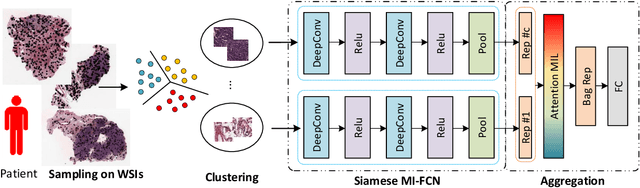
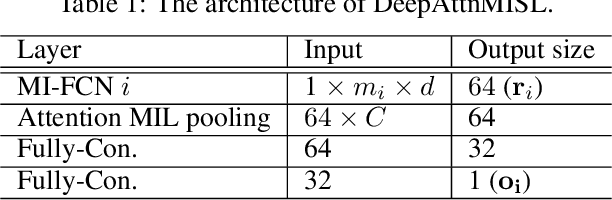

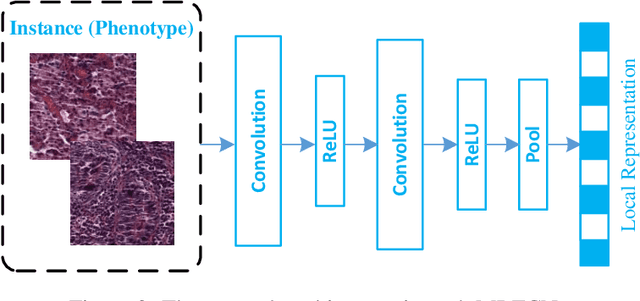
Traditional image-based survival prediction models rely on discriminative patch labeling which make those methods not scalable to extend to large datasets. Recent studies have shown Multiple Instance Learning (MIL) framework is useful for histopathological images when no annotations are available in classification task. Different to the current image-based survival models that limit to key patches or clusters derived from Whole Slide Images (WSIs), we propose Deep Attention Multiple Instance Survival Learning (DeepAttnMISL) by introducing both siamese MI-FCN and attention-based MIL pooling to efficiently learn imaging features from the WSI and then aggregate WSI-level information to patient-level. Attention-based aggregation is more flexible and adaptive than aggregation techniques in recent survival models. We evaluated our methods on two large cancer whole slide images datasets and our results suggest that the proposed approach is more effective and suitable for large datasets and has better interpretability in locating important patterns and features that contribute to accurate cancer survival predictions. The proposed framework can also be used to assess individual patient's risk and thus assisting in delivering personalized medicine. Codes are available at https://github.com/uta-smile/DeepAttnMISL_MEDIA.
* 22 pages, 13 figures, published in Medical Image Analysis 65, 101789